Why Reducing Biological Age Matters
Lowering an individual's biological age cuts the incidence of chronic diseases that drive 60 % of U.S. health‑care spending. A 5‑10‑year reduction can shrink annual medical costs by 15‑30 % (≈ $1,500–$2,000 per person) and delay expensive hospitalizations, long‑term care, and medication use. Proactive longevity clinics—using epigenetic monitoring, personalized nutrition, exercise, and senolytic therapies—identify decline early, compress morbidity, and keep older adults in the workforce longer. Modeling shows a 5‑year biological‑age cut across a cohort could save $150 billion annually and generate a 3:1 ROI, demonstrating that preventive, precision care is both a health and economic imperative.
Understanding the Longevity Economy and Its Principles
| Core Principle | Description | Policy/Business Implication |
|---|---|---|
| Financial resilience across life events | Ensure income security through savings, insurance, and adaptable retirement plans | Design products that adjust to health shocks and career changes |
| Universal financial education | Provide accessible financial literacy for all ages | Public‑private education programs, digital tools |
| Prioritizing healthy aging | Promote preventive care, nutrition, exercise, mental health | Incentivize wellness services, reimburse preventive interventions |
| Lifelong workforce participation | Enable older adults to stay employed or transition to flexible roles | Upskilling, age‑inclusive hiring policies |
| Social connection & purpose | Foster community engagement and meaningful activities | Community centers, volunteer platforms |
| Addressing longevity inequalities | Reduce disparities in access to care and economic resources | Targeted subsidies, inclusive design |
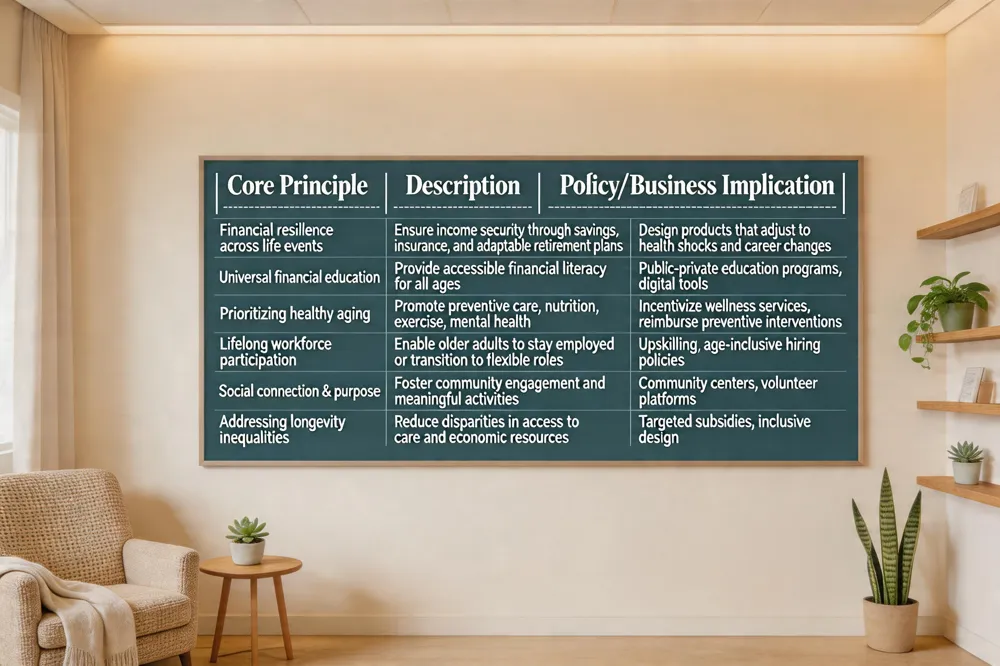 The longevity economy encompasses the full market of goods and services that serve people aged 50 plus, generating over $8 trillion in the United States alone and projected to exceed $30 trillion globally by 2030. Its six core principles—financial resilience across life events, universal financial education, prioritizing healthy aging, lifelong workforce participation, social connection and purpose, and addressing longevity inequalities—guide policymakers and businesses toward inclusive, sustainable growth. Joseph F. Coughlin’s MIT AgeLab book reframes aging as a market opportunity, highlighting women’s disproportionate influence on spending and the $7.5 trillion contribution of older adults to U.S. GDP in 2022. The World Economic Forum’s Longevity Economy Principles call for coordinated action among governments, firms, and civil society to redesign retirement, health‑care financing, and caregiving models, emphasizing the projected 2.1 billion global population over 60 by 2050. AARP’s Longevity Economy Outlook reports that the 50‑plus cohort already accounts for 40 % of U.S. GDP, supports 88 million jobs, and contributes $745 billion in unpaid volunteering, underscoring the economic imperative of preventive, personalized longevity interventions.
Health Trends, Purposeful Aging, and Lifestyle Choices
| Trend / Habit | Positive Impact | Negative Impact / Risk |
|---|---|---|
| Functional nutrition & targeted supplements | Improves bone density, cardiovascular health | Over‑supplementation, cost |
| Wearable‑driven activity monitoring | Enables personalized activity goals | Data privacy concerns |
| Mindfulness & stress‑reduction | Supports mental well‑being, slower cellular aging | Requires consistent practice |
| Technology adoption (tele‑health, apps) | Increases access to care, self‑monitoring | Digital divide |
| Smoking/vaping | Accelerates biological aging | ↑ disease risk |
| Sedentary behavior | Reduces muscle mass, cardiovascular fitness | ↑ healthcare costs |
| Chronic stress | Shortens telomeres, impairs immunity | ↑ mental health disorders |
| Poor sleep | Impairs metabolic health | ↑ chronic disease risk |
| Unhealthy eating | Increases inflammation, obesity | ↑ healthcare spending |
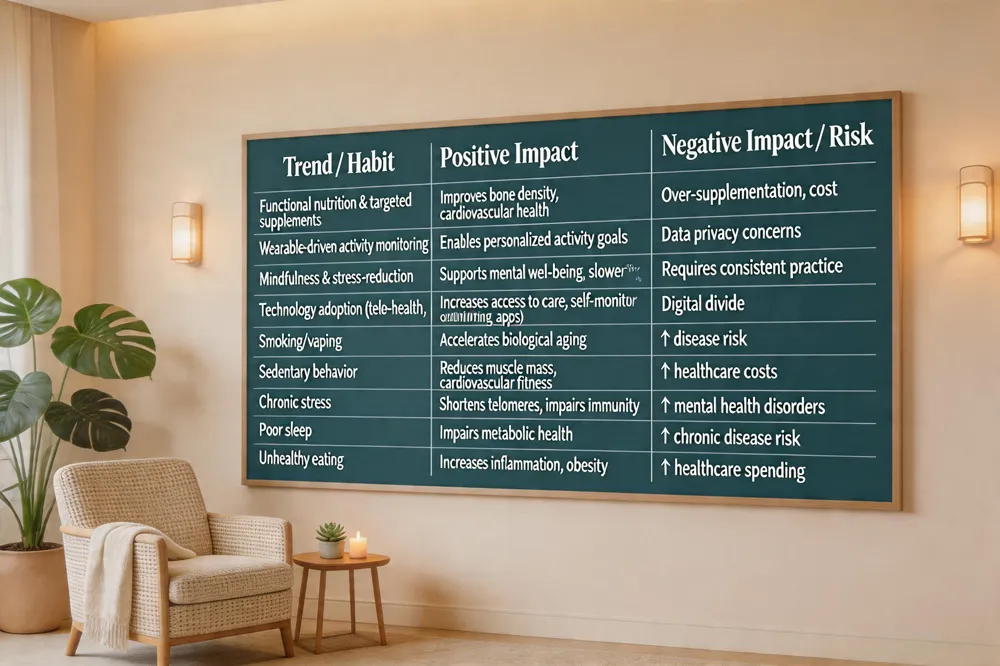 Current health trends emphasize personalized, science‑backed approaches that blend nutrition, fitness, and mental‑well‑being. Older adults are gravitating toward functional nutrition, targeted supplements, and wearable‑driven activity monitoring to maintain bone density and cardiovascular health while integrating mindfulness and stress‑reduction practices. Aging with purpose means intentionally engaging in activities that nurture personal growth, social connection, and contribution; programs that combine purpose‑driven goals with personalized exercise and nutrition support both physical and mental vitality. Many seniors view healthy aging as a holistic pursuit that transcends chronological years, prioritizing independence, meaningful community roles, and technology adoption to stay active and financially stable. Conversely, five daily habits—smoking or vaping, sedentary behavior, chronic stress, poor sleep, and unhealthy eating—are linked to accelerated biological aging. To minimize healthcare costs, health systems must focus on effective labor management, optimize patient‑encounter workflows, leverage analytics and digital tools for precise cost tracking, and improve patient access and flow across the continuum, thereby reducing waste and supporting value‑based care.
Economic Value of Targeting Aging and Cost‑Saving Opportunities
| Economic Metric | Estimate | Source / Note |
|---|---|---|
| Value of 1 healthy year added | $38 trillion (U.S.) | Buck Institute analysis |
| Value of 10 healthy years added | $367 trillion (U.S.) | Buck Institute analysis |
| Contribution of 50+ cohort to U.S. GDP (2022) | 40 % | AARP Longevity Economy Outlook |
| Unpaid volunteering value (2022) | $745 billion | AARP Longevity Economy Outlook |
| Cost‑saving interventions | Preventive screening, nutrition, exercise, targeted lifestyle drugs, deferred‑income annuities | General industry data |
| Six shifts for healthy aging | 1) Preventive programs 2) Data standards 3) Scale interventions 4) Ecosystem innovation 5) Cross‑industry support 6) Autonomy & lifelong learning | Article summary |
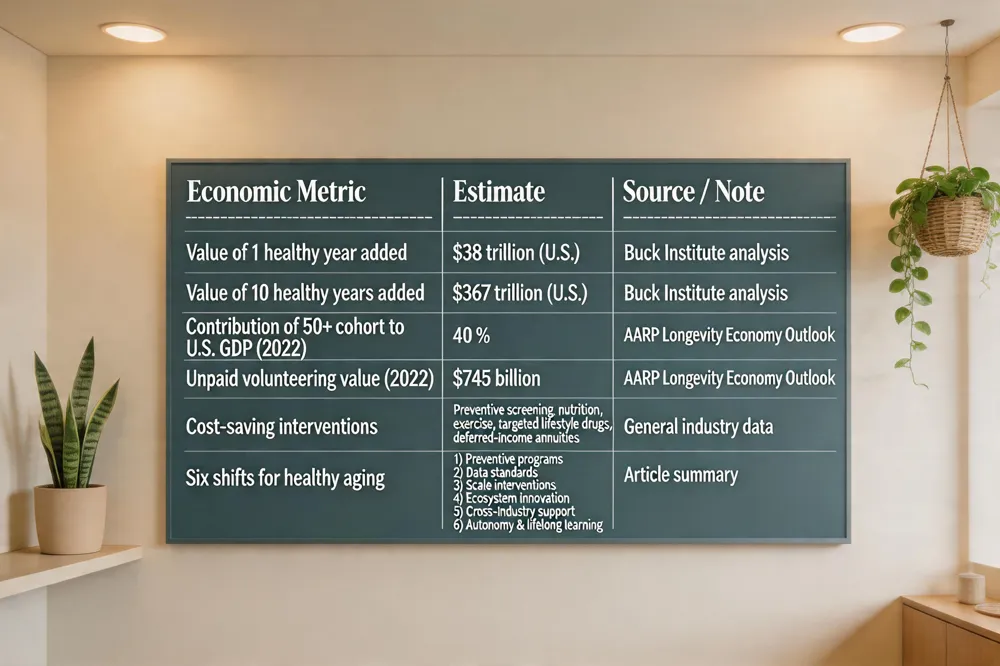
Economic value of targeting aging
A modest slowdown adding one healthy year could generate about US $38 trillion could a ten‑year gain may be worth US $367 trillion. Benefits arise from productivity, workforce participation and reduced chronic‑disease costs.
Cost‑savings examples in longevity
Preventive screening, nutrition and exercise lower medical bills. Targeted lifestyle drugs cut medication and hospital expenses. Insurance such as deferred‑income annuities protects savings.
Economics of aging
A larger older‑adult share raises Medicare and private‑insurer spending while concentrating wealth in seniors. Longer lives pressure pension systems and shift retirement timing, prompting reforms.
Six shifts needed for healthy aging and longer life
- Invest in preventive programs; 2) Improve measurement and data standards; 3) Scale proven interventions like diet and activity; 4) Accelerate ecosystem innovation; 5) Harness all industries to support aging; 6) Empower older adults through autonomy and lifelong learning.
Introduction to the economics of longevity
Extended lifespans reshape consumption, savings and productivity; cycle models examine impacts on pension, health financing and growth, guiding policies that turn added years into welfare.
Competitive Landscape of Longevity Services
| Feature | Geviti | Mito Health | Function Health |
|---|---|---|---|
| Pricing model | Membership $0‑$150/mo (Free, Lite, Plus, Plus Rx) | Single‑visit AI panel, price not disclosed | $365 annual fee |
| Biomarker coverage | 100+ biomarkers, 2 panels/year | Limited panel (single visit) | >100 biomarkers, annual + follow‑up |
| Sample collection | At‑home blood draws | In‑clinic draw (if any) | In‑person lab visits |
| Coaching / support | Ongoing health coaching, dedicated team | Brief consult | Basic dashboards |
| Prescription options | Hormone/peptide therapies, member pricing | None | None |
| Supplement protocol | Custom supplement protocol, $120‑$200/mo | None | None |
| Target market | Proactive health, comprehensive longevity | Quick AI‑driven assessment | Annual comprehensive testing |
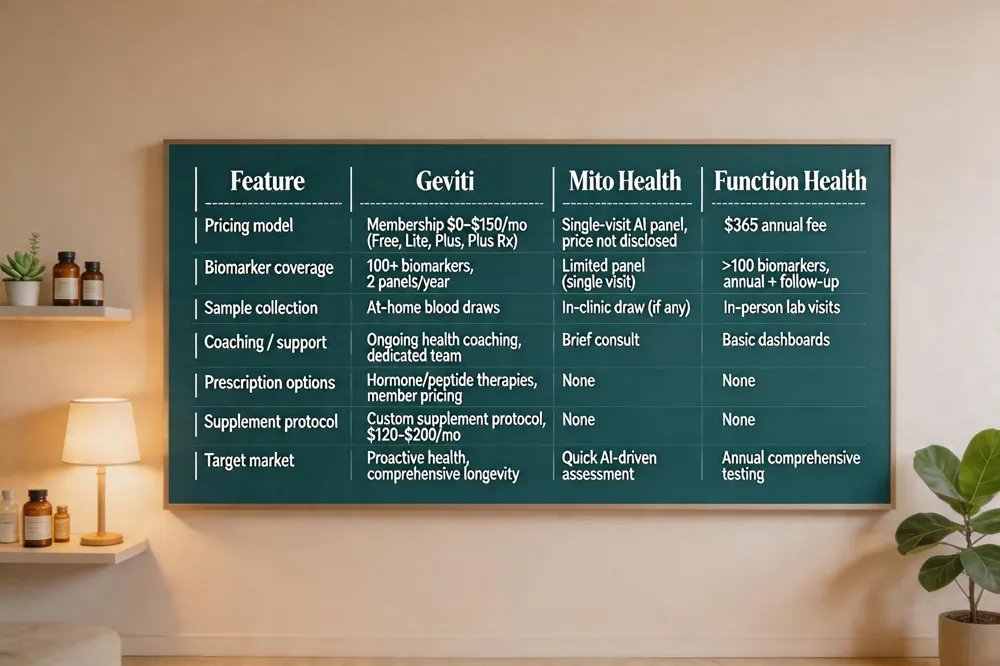 Geviti competes with other longevity‑focused platforms that combine extensive biomarker testing and personalized coaching. The most frequently cited rivals are Mito Health, which offers a single‑visit AI‑driven blood panel and brief health‑coach consult, and Function Health, which provides annual testing of over 100 biomarkers with a follow‑up panel but no at‑home draw. Both target the proactive‑health market and compete on pricing, convenience, and breadth of clinical support, while broader health‑optimization brands also bundle lab testing, supplement protocols, and prescription therapies.
Geviti vs. Function Health – Geviti uses a membership model ($66‑$150 per month) that includes two comprehensive panels each year, at‑home blood draws, optional prescription therapies, and ongoing coaching. Function Health charges a $365 annual fee for one full panel plus a follow‑up, requires in‑person lab visits, and offers only basic data dashboards. Geviti’s added services—supplement protocols, health coaching, hormone or peptide prescriptions—provide richer hands‑on guidance.
Geviti cost – Free plan ($0/month) offers basic analysis and health blueprint. Lite ($66.67/month) adds a 100‑plus biomarker panel, at‑home draws, and a custom supplement protocol. Plus ($150/month) provides quarterly testing, a dedicated health team, full prescription access, and member pricing on supplements. Plus Rx ($149.83/month) expands prescription options. Longeviti Blend supplements cost $120‑$200 per month depending on tier.
Brain‑health companies – Notable U.S. players include BrainHealth USA (psychiatry and mental‑wellness in Los Angeles), BrainHealth Consults (remote cognitive testing, biomarker analysis, tele‑neurology), and the Brain Health Center (accelerated TMS for depression and anxiety). These firms illustrate the expanding market for personalized, technology‑driven brain‑health solutions.
Future Outlook: Trends, Programs, and Policy
| Trend / Program | Implication for Longevity Economy |
|---|---|
| Modern retirement & decumulation strategies | Align savings with longer healthy lifespans |
| Multigenerational workplace wellness | Retain talent, reduce turnover costs |
| AI‑driven health analytics | Early detection, personalized interventions |
| Flexible caregiving models | Support informal caregivers, reduce institutional costs |
| Climate‑resilient infrastructure | Protect health of aging populations from environmental risks |
| Biomarker‑based aging clocks | Guide preventive therapies, extend healthspan |
| Scaling brain‑health interventions | Reduce disability‑adjusted life years, boost productivity |
| McKinsey insights on aging workforce | Need for upskilling, flexible work for 65+ |
| Life‑cycle economic models | Inform policy on pensions, healthcare financing |
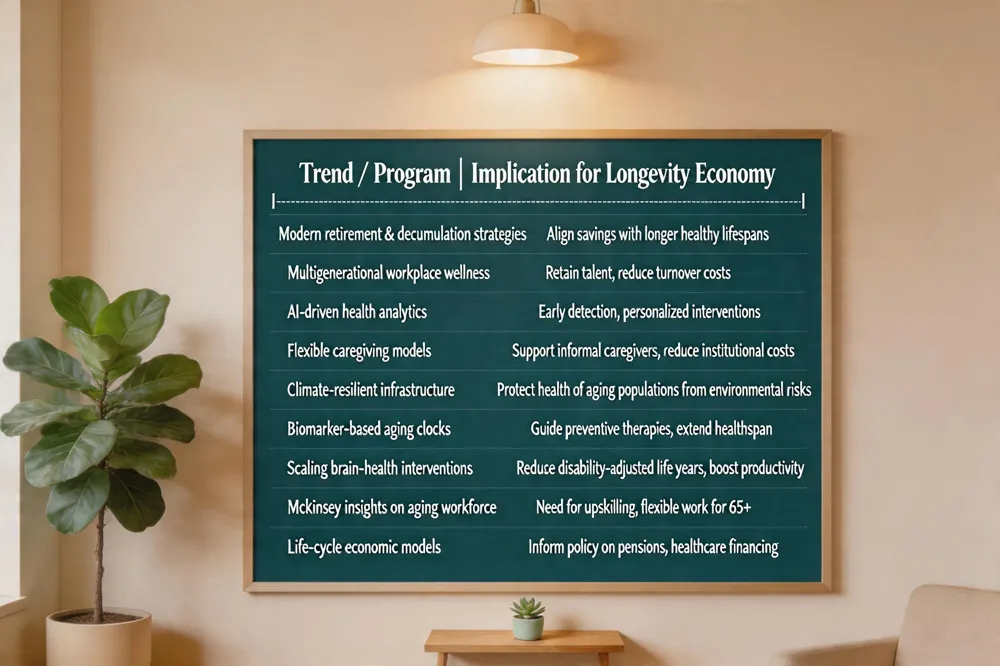 Future‑proofing the longevity economy – Sustainable growth requires modern retirement schemes, inclusive financial products for gig workers, and decumulation strategies that match longer, healthier lives. Employers must embed multigenerational wellness programs, while AI‑driven health analytics, flexible caregiving models, and climate‑resilient infrastructure mitigate emerging risks and unlock new market opportunities.
Meaning of delaying aging – Delaying aging slows the biological processes that accumulate cellular damage, extending the period of good health. Biomarker‑based aging clocks guide early interventions—dietary restriction, gut‑microbiota optimization, autophagy and TOR signaling modulation—to keep repair mechanisms functional longer, postponing chronic disease onset.
Scaling brain‑health interventions – Early screening, lifestyle coaching, and evidence‑based therapies can avert millions of disability‑adjusted life years, translating into healthcare savings and higher labor‑force productivity. Digital therapeutics and personalized plans enable rapid, scalable delivery without compromising quality.
McKinsey on aging population – The share of people aged 65+ is set to double by 2050, driving demand for personalized preventive‑medicine models. Flexible work arrangements and upskilling older employees are essential to maintain labor participation and capture the economic upside of a healthier, longer‑living workforce.
Introduction to the economics of longevity – Longer, healthier lives reshape consumption, savings, labor markets, and healthcare financing. Life‑cycle models now assess how extended healthspan affects GDP, pension sustainability, and productivity, guiding policies that turn longevity into a net economic benefit.
Turning Insight into Action
Investing in biological‑age reduction cuts chronic‑disease costs by 15‑20 %, saving up to $30 k per person and adding $150 billion annually to the U.S. economy. Personalized longevity programs—nutrition, exercise, senolytics—deliver these gains. The Medical Institute of Healthy Aging offers expert biomarker‑driven plans to start your health‑span journey today for lasting vitality now.