Introduction: The Promise of Regenerative Medicine
Stem cell therapy harnesses the body’s innate repair capacity by delivering autologous or allogeneic cells that can differentiate into cartilage‑forming chondrocytes, modulate inflammation, and secrete regenerative exosomes. In joint health, mesenchymal stem cells (MSCs) sourced from bone marrow, adipose tissue, or synovial fluid have shown safety and modest pain relief in knee osteoarthritis, while iPSC‑derived chondrocytes and embryonic‑MSC exosomes improve collagen II synthesis and reduce catabolic enzymes. Core concepts include direct differentiation into chondrocytes, paracrine signaling via secretomes, and tissue engineering platforms such as 3‑D bioprinting and cell‑sheet constructs that preserve extracellular matrix cues. Personalized protocols consider patient age, BMI, defect size, and regulatory‑compliant GMP manufacturing to maximize efficacy and health‑span benefits. These advances also enable monitoring of cartilage regeneration through MRI and biomarker analysis, supporting evidence‑based adjustments over time.
Cartilage Regeneration: Stem Cells in Action
Key Features of MSC‑Based Cartilage Regeneration
| Therapy | Cell Source | Delivery Method | Main Benefits | Main Limitations |
|---|---|---|---|---|
| Autologous MSC injection | Bone‑marrow or adipose (autologous) | Intra‑articular injection (often with PRP) | Minimal invasiveness, low immunogenicity, early pain relief | Variable regenerative outcomes, limited long‑term data, high cost |
| RECLAIM technique | Allogeneic MSCs + debrided cartilage fragments (chondrons) | Single operative session, scaffold‑free construct | Combines cellular and matrix components, potentially higher cartilage quality | Regulatory uncertainty, higher procedural complexity |
| MSC + PRP combo | Autologous MSCs + autologous platelet‑rich plasma | Injection (often ultrasound‑guided) | Enhanced anabolic signaling, improved tissue healing | Still investigational, cost adds up |
| MSC‑seeded scaffold (e.g., 3‑D bioprinted) | Autologous or allogeneic MSCs | Implantation of bio‑ink construct | Structured tissue architecture, scalable | Requires GMP facilities, higher expense |
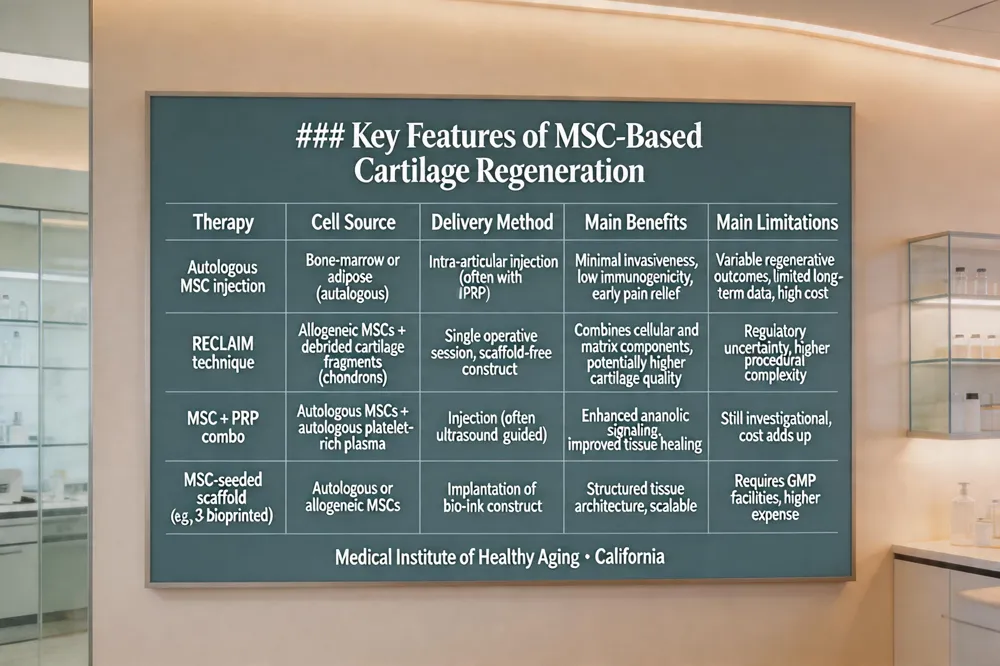 Stem cell therapy for knee cartilage regeneration involves delivering mesenchymal stem cells (MSCs)—often autologous bone‑marrow or adipose‑derived—directly into focal cartilage defects. The cells differentiate into chondrocytes, secrete anti‑inflammatory cytokines, and produce extracellular matrix components such as collagen type II, recreating a hyaline‑like surface. Clinical protocols range from simple intra‑articular injections to engineered constructs like the RECLAIM technique, which combines debrided cartilage fragments (chondrons) with allogeneic MSCs in a single operative session.
Pros include minimal invasiveness, low immunogenicity, and early pain relief; cons involve variable regenerative outcomes, high cost, limited long‑term data, and regulatory uncertainty.
Evidence shows stem cells can contribute to cartilage repair, especially in early‑stage osteoarthritis, but regeneration is modest compared with native tissue.
The most consistently effective approach to autologous MSC injections—preferably adipose‑derived—often paired with platelet‑rich plasma to enhance anabolic signaling. Selecting the optimal therapy requires individualized assessment of disease severity, patient age, and joint biomechanics.
Beyond Joints: Diseases and Cell Types
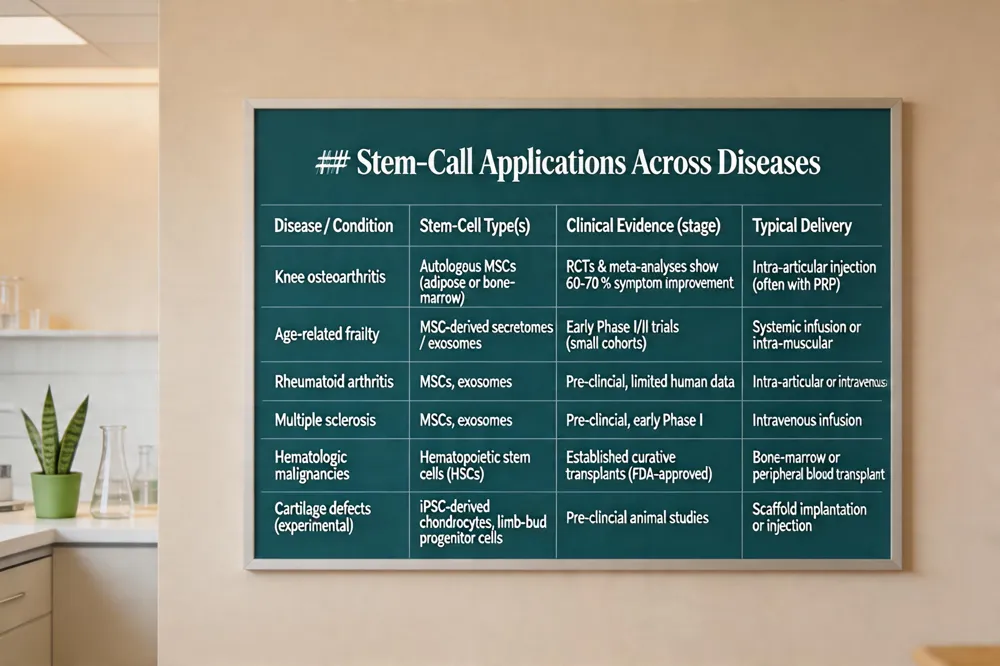
Stem‑Cell Applications Across Diseases
| Disease / Condition | Stem‑Cell Type(s) | Clinical Evidence (stage) | Typical Delivery |
|---|---|---|---|
| Knee osteoarthritis | Autologous MSCs (adipose or bone‑marrow) | RCTs & meta‑analyses show 60‑70 % symptom improvement | Intra‑articular injection (often with PRP) |
| Age‑related frailty | MSC‑derived secretomes / exosomes | Early Phase I/II trials (small cohorts) | Systemic infusion or intra‑muscular |
| Rheumatoid arthritis | MSCs, exosomes | Pre‑clinical, limited human data | Intra‑articular or intravenous |
| Multiple sclerosis | MSCs, exosomes | Pre‑clinical, early Phase I | Intravenous infusion |
| Hematologic malignancies | Hematopoietic stem cells (HSCs) | Established curative transplants (FDA‑approved) | Bone‑marrow or peripheral blood transplant |
| Cartilage defects (experimental) | iPSC‑derived chondrocytes, limb‑bud progenitor cells | Pre‑clinical animal studies | Scaffold implantation or injection |
 Which diseases can be treated with stem cell therapy?
Stem cell approaches are being explored for a wide range of chronic and degenerative disorders. In orthopedics, autologous Mesenchymal stem cells (MSCs) improve pain and function in knee osteoarthritis and may slow cartilage loss, as shown in Japanese trials and the MILES study. Beyond joints, MSC‑derived secretomes and exosomes reduce systemic inflammation and have been investigated for age‑related frailty, rheumatoid arthritis, and multiple sclerosis. Early pre‑clinical work suggests that iPSC‑derived chondrocytes and limb‑bud progenitor cells can regenerate cartilage, while hematopoietic stem cell transplants remain the gold standard for hematologic malignancies.
What types of stem cells are used in regenerative medicine?
Regenerative medicine relies chiefly on three categories: (1) Pluripotent cells – embryonic stem cells and induced pluripotent stem cells (iPSCs), which can be differentiated into any tissue type, including chondrocytes for cartilage repair; (2) Multipotent MSCs – harvested from bone marrow, adipose tissue, umbilical cord, or synovial membrane, prized for chondrogenic potential, paracrine immunomodulation, and exosome delivery; (3) Hematopoietic stem cells (HSCs) – used in blood‑cell transplantation for cancer and immune disorders. Tissue‑specific progenitors such as cartilage‑derived stem cells and meniscus‑derived stromal cells are also emerging.
What are the different types of stem cell therapy?
Therapies fall into several groups: (a) Hematopoietic stem‑cell transplantation, a regulated, curative treatment for blood cancers; (b) MSC‑based intra‑articular injections for osteoarthritis and cartilage defects, often combined with PRP and exosomes or scaffold technologies like 3‑D bioprinting; (c) iPSC‑derived cellular products, currently investigational for cartilage regeneration and other organ‑specific repairs; and (d) Unapproved “stem‑cell” injections, which lack rigorous clinical validation and may pose safety risks. All approaches require Good Manufacturing Practice (GMP)‑compliant production and robust regulatory oversight.
Practical Considerations: Cost, Coverage, and Access
Economic & Access Landscape (2026)
| Item | Typical Cost (USD) | Insurance Coverage | Notable U.S. Centers |
|---|---|---|---|
| Single‑knee MSC injection (incl. imaging & post‑care) | $3,500 – $25,000 (base) <br> $5,000 – $30,000 (total) | Rarely covered; classified as experimental | NYU Langone Health – Regenerative Orthopedic Medicine (NY) <br> Regenerative Orthopedics (Fort Worth, TX) |
| MSC + PRP combo | $4,000 – $28,000 | Usually not covered | Same as above, plus many private “regenerative” clinics |
| Scaffold‑based or bioprinted construct | $10,000 – $45,000 | Not covered (investigational) | Select academic centers with GMP labs |
| Back‑pain MSC/PRP therapy (experimental) | $2,500 – $15,000 | Not covered | Limited to specialized pain‑management clinics |
 Stem‑cell therapy for knee injuries remains an out‑of‑pocket service. In 2026 a single‑knee injection typically costs $3,500‑$25,000, with additional fees for imaging, guidance and post‑procedure therapy often pushing the total to $5,000‑$30,000. Insurance rarely covers these procedures because they are deemed experimental; only FDA‑approved hematologic transplants receive Medicare or private reimbursement. Patients therefore must pay cash or use financing. Reputable U.S. centers include NYU Langone Health’s Center for Regenerative Orthopedic Medicine (New York) and Regenerative Orthopedics in Fort Worth, Texas, both offering autologous bone‑marrow or adipose‑derived MSC injections on an outpatient basis. Similar clinics exist nationwide. For back pain, regenerative approaches such as MSC or PRP injections are being studied; early reports of pain reduction and functional gain. However, the evidence is still limited, protocols are not standardized, and regulatory agencies classify these treatments as investigational. Consequently, patients should view back‑pain regenerative therapy as a promising yet experimental option, typically offered after conventional care has failed.
Outcomes and Monitoring: Success Rates and Patient Experience
Clinical Outcomes Summary
| Outcome Metric | Reported Results | Timeframe of Improvement | Adverse Events (frequency) |
|---|---|---|---|
| Pain relief (VAS) | 60‑70 % of patients achieve ≥2‑point drop | 1–2 weeks (early), 4–12 weeks (peak) | Mild injection‑site pain (≈10 %) |
| Functional scores (IKDC, WOMAC) | Clinically meaningful gain in 60‑70 % | 4–12 weeks, sustained to 24 months in trials | Rare infection (<1 %) |
| Cartilage quality (MRI/ultrasound) | Modest thickness increase, hyaline‑like tissue in subset | 6–12 months | No major cartilage overgrowth reported |
| Long‑term durability | Limited data beyond 2 years; benefit may wane | — | — |
| Patient satisfaction | High (≈80 % would repeat) when pain improves | — | — |
 Current clinical evidence indicates that stem‑cell injections for knee osteoarthritis produce clinically meaningful pain relief or functional improvement in roughly 60 %‑70 % of appropriately selected patients. A 2020 meta‑analysis of nine randomized trials (339 participants) showed significant reductions in Visual Analogue Scale scores and gains in IKDC and WOMAC scores at 24 months, while the MILES multicenter trial (480 patients) reported that two‑thirds of participants experienced sustained benefit comparable to corticosteroid injections, with low adverse‑event rates.
Despite these promising figures, stem‑cell therapy remains limited by several disadvantages. Long‑term efficacy is not yet proven; many studies demonstrate only modest, short‑term symptom relief. The procedure is costly, often performed in unregulated clinics, and carries risks of injection‑site pain, inflammation, infection, or unintended tissue differentiation. Regulatory constraints on cell manipulation further hinder standardization and quality control.
Effectiveness for joint pain is therefore modest and not consistently superior to established treatments, and robust evidence of cartilage regeneration in humans is lacking.
Patients assess therapeutic response by tracking pain intensity, mobility, and daily function. Early anti‑inflammatory effects may appear within one to two weeks, while noticeable improvements in range of motion and reduced chronic pain typically emerge between weeks 4‑12. Objective measures—range‑of‑motion tests, strength assessments, and follow‑up imaging—combined with regular clinical follow‑ups, help confirm treatment efficacy and guide any necessary adjustments.
Emerging Innovations and Future Directions
Cutting‑Edge Platforms Poised to Transform Therapy
| Innovation | Mechanism of Action | Development Stage (2026) | Expected Clinical Impact |
|---|---|---|---|
| miR‑140‑5p‑engineered exosomes | Up‑regulate collagen‑II, down‑regulate ADAMTS5, promote chondrocyte proliferation | Pre‑clinical (large‑animal models) | Enhanced cartilage matrix deposition |
| iPSC‑derived neural‑crest chondrocytes (NCC‑Chs) | Mimic native joint chondrocyte phenotype, better integration | Early‑phase translational studies | Superior repair quality vs. MSCs |
| 3‑D bioprinting with bio‑active inks (MSC + biomimetic scaffold) | Spatially controlled cell placement, ECM mimicry | GMP‑compliant pilot trials | Scalable, patient‑specific cartilage implants |
| Organ‑on‑a‑chip joint models | Replicate synovial fluid dynamics for high‑throughput testing | Established platform for drug & cell product screening | Faster pre‑clinical validation, reduced animal use |
| Standardized GMP potency assays (e.g., collagen‑II secretion, immunomodulatory index) | Ensure batch‑to‑batch consistency & safety | Regulatory‑driven implementation | Improved regulatory acceptance, broader reimbursement |
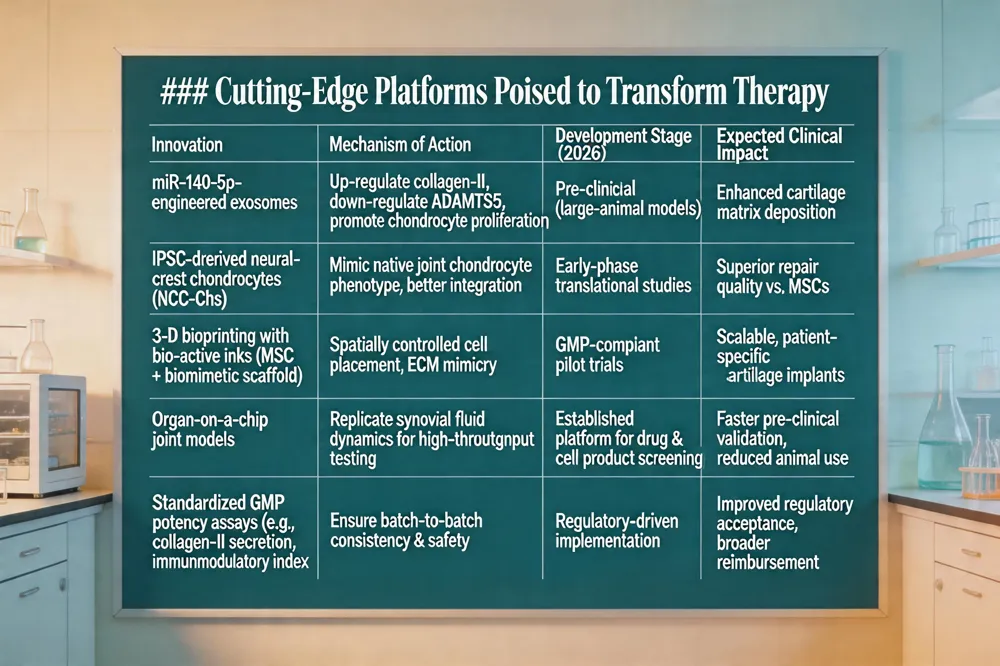 Research on cartilage regeneration is converging on several cutting‑edge platforms that promise to move stem‑cell therapies from experimental to clinically reliable options. Exosomes engineered to over‑express miR‑140‑5p, derived from embryonic or synovial MSCs, have been shown to boost collagen‑II synthesis while suppressing catabolic enzymes such as ADAMTS5, thereby enhancing chondrocyte proliferation and migration in osteoarthritis models. Parallel advances in induced pluripotent stem cell (iPSC) technology enable the generation of neural‑‑‑derived chondrocytes (NCC‑Chs) that more closely resemble native joint cells than mesoderm‑derived counterparts, delivering superior cartilage repair in rodent studies. Three‑dimensional bioprinting combined with bioactive inks containing MSCs and biomimetic scaffolds now produces tissue constructs that recapitulate native extracellular matrix, supporting robust chondrogenesis and offering a scalable route to implantation. To translate these innovations, Good Manufacturing Practice (GMP)‑compliant differentiation protocols and potency assays are being standardized, ensuring reproducibility, safety, and regulatory acceptance. Finally, organ‑on‑a‑chip platforms that mimic joint microenvironments—including synovial fluid dynamics—provide high‑throughput, physiologically relevant testing of stem‑cell‑based therapeutics, accelerating pre‑clinical validation and informing clinical trial design.
Conclusion: Navigating the Regenerative Landscape
Key takeaways: Stem‑cell therapies show promise for cartilage repair but evidence varies; safety is solid, efficacy remains modest. Patient guidance: Choose GMP‑compliant, FDA‑regulated clinics; consult orthopedic specialists, consider age, BMI, defect size, and set realistic expectations about pain relief versus true regeneration. Future outlook: Standardized protocols, iPSC‑derived chondrocytes, 3‑D bioprinting, and exosome engineering may unlock durable, personalized joint rejuvenation for aging patients.