Why AI is Transforming Preventive Health
AI‑driven platforms now fuse fragmented health records, wearable streams, genomics, and lifestyle surveys into a single, HIPAA‑compliant data lake. By applying large‑language models and predictive analytics, they generate hyper‑personalized recommendations—such as daily step targets, nutrient timing, or medication adjustments—tailored to an individual’s genetic risk, epigenetic age, and real‑time biometrics. This massive integration enables scalable preventive interventions, allowing millions of users to receive evidence‑based nudges, early disease alerts, and dynamic coaching without overburdening clinicians and improving population health outcomes worldwide significantly.
The Foundations of Personalized Preventive Care
Key Concepts
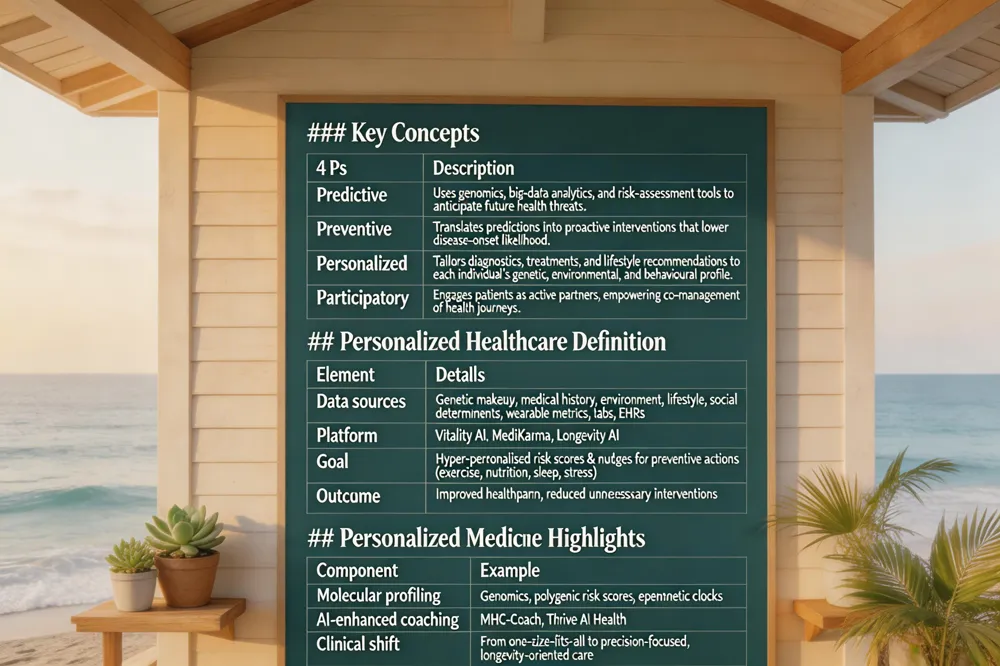
| 4 Ps | Description |
|---|---|
| Predictive | Uses genomics, big‑data analytics, and risk‑assessment tools to anticipate future health threats. |
| Preventive | Translates predictions into proactive interventions that lower disease‑onset likelihood. |
| Personalized | Tailors diagnostics, treatments, and lifestyle recommendations to each individual’s genetic, environmental, and behavioural profile. |
| Participatory | Engages patients as active partners, empowering co‑management of health journeys. |
Personalized Healthcare Definition
| Element | Details |
|---|---|
| Data sources | Genetic makeup, medical history, environment, lifestyle, social determinants, wearable metrics, labs, EHRs |
| Platforms | Vitality AI, MediKarma, Longevity AI |
| Goal | Hyper‑personalised risk scores & nudges for preventive actions (exercise, nutrition, sleep, stress) |
| Outcome | Improved healthspan, reduced unnecessary interventions |
Personalized Medicine Highlights
| Component | Example |
|---|---|
| Molecular profiling | Genomics, polygenic risk scores, epigenetic clocks |
| AI‑enhanced coaching | MHC‑Coach, Thrive AI Health |
| Clinical shift | From one‑size‑fits‑all to precision‑focused, longevity‑oriented care |
 What are the 4 Ps of personalized medicine?
The 4 Ps are Predictive, Preventive, Personalized, and Participatory. Predictive medicine uses genomics, big‑data analytics, and risk‑assessment tools to anticipate future health threats before they manifest. Preventive medicine translates those predictions into proactive interventions that lower disease‑onset likelihood. Personalized medicine tailors diagnostics, treatments, and lifestyle recommendations to each individual’s genetic, environmental, and behavioural profile. Participatory medicine engages patients as active partners, empowering them to co‑manage their health journeys and make informed decisions.
What does personalized healthcare mean?
Personalized healthcare is a proactive, data‑driven approach that creates a unique health plan for each person by integrating genetic makeup, medical history, environment, lifestyle, and social determinants. AI‑driven platforms (e.g., Vitality AI, MediKarma, Longevity AI) fuse wearable metrics, lab results, and electronic health records to generate hyper‑personalised risk scores and nudges. The model emphasizes collaborative patient‑provider partnerships, focusing on preventive actions such as tailored exercise, nutrition, sleep, and stress management to improve healthspan while reducing unnecessary interventions.
What is personalized medicine?
Personalized medicine tailors prevention, diagnosis, and treatment to an individual’s molecular and lifestyle profile. By analysing genomics, biomarkers, and omics data (e.g., polygenic risk scores, epigenetic clocks), clinicians can predict disease risk, select the most effective therapies, and optimise dosage. AI‑enhanced coaching platforms (e.g., MHC‑Coach, Thrive AI Health) embed these insights into real‑time, scalable guidance, shifting care from a one‑size‑fits‑all paradigm to a precision‑focused, longevity‑oriented framework.
AI‑Powered Coaching Modalities and Clinical Impact
Coaching Modality Effectiveness
| Modality | Feasibility | Acceptability | Retention / Completion |
|---|---|---|---|
| Human‑led | Highest | Highest | Up to 100 % |
| AI‑only chatbots | Moderate | Moderate | As low as 27 % |
| Hybrid (AI + Human) | Promising | Good | Still lower than pure human |
Clinical Impact of AI Integration
| Metric | Improvement |
|---|---|
| Screening rates | +22 % |
| Early cancer detection | +19 % |
| Cost per patient (longevity clinic) | $20,000 for bundled biomarker, genomics, AI‑guided plan |
| Healthspan extension | Modest (pilot studies) |
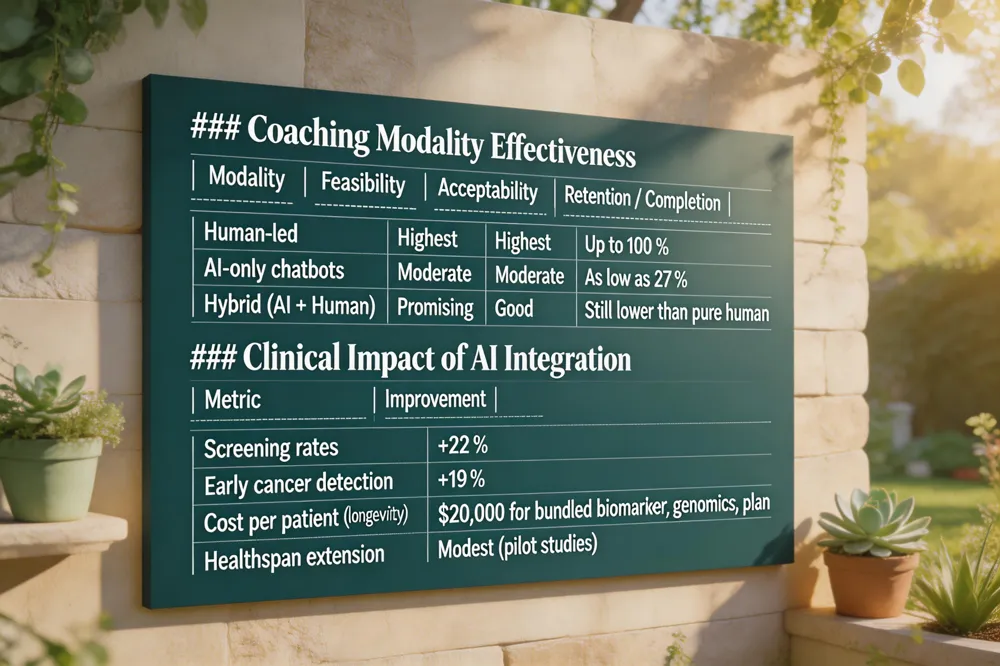 Recent systematic reviews of 35 digital‑health studies reveal a clear hierarchy among coaching modalities. Human‑led coaching consistently achieves the highest feasibility, acceptability and retention (up to 100 % completion), driven by strong therapeutic alliance and empathy. AI‑only chatbots, while delivering impressive improvements in physical activity and diet, show lower engagement (completion rates as low as 27 %) and mixed long‑term behaviour change. Hybrid models that blend AI‑driven analytics with human relational support are promising but still require refinement to match pure human coaching on sustained outcomes.
In clinical settings, AI integration of fragmented health data—exemplified by Vitality AI’s use of Google Vertex AI and Gemini—has lifted screening rates by 22 % and early cancer detection by 19 %, demonstrating that hyper‑personalised recommendations can be scaled without overburdening providers. Longevity clinics charging $20,000 typically bundle comprehensive biomarker panels, genomics, and AI‑guided lifestyle plans. While early detection of risk factors can modestly extend healthspan, the evidence base for dramatic lifespan gains remains limited; many interventions are extrapolated from pilot studies rather than large‑scale trials. Consequently, the cost‑benefit balance favours wellness optimisation and disease prevention over guaranteed longevity extensions.
Behavior‑Change Frameworks and Coaching Techniques
30 % Rule for AI in Education
| Rule | Purpose |
|---|---|
| ≤30 % of student work generated by AI | Preserve authentic learning, develop critical thinking |
Enforcement | Plagiarism‑detection software, transparent disclosure policies |
Professional Coaching Categories
| Category | Focus |
|---|---|
| Business coaching | Leadership & organisational performance |
| Life‑vision & enhancement coaching | Personal goals & values |
| Career coaching | Job transitions & skill development |
| Health‑and‑wellness coaching | Physical, mental, emotional well‑being |
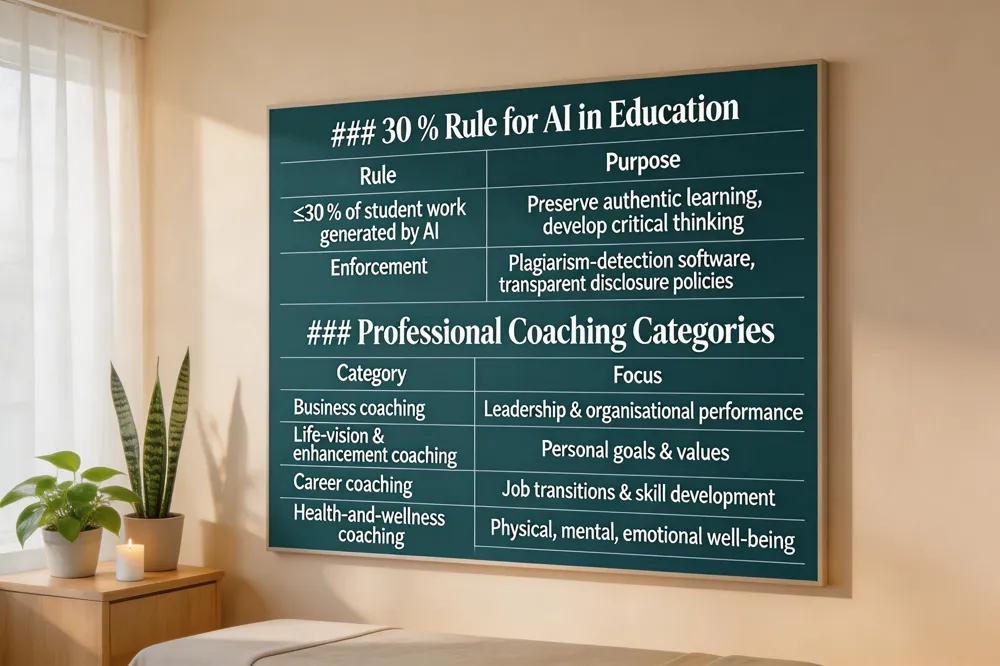 The 30 % rule for AI in education is a guideline that no more than 30 % of a student’s submitted work should be generated by generative AI tools. The aim is to preserve authentic learning experiences, ensuring students develop critical thinking and problem‑solving skills while still allowing limited AI assistance for efficiency. Institutions typically enforce this through plagiarism‑detection software and transparent disclosure policies.
Professional coaching falls into four primary categories: business coaching, which targets leadership and organisational performance; life‑vision and enhancement coaching, which clarifies personal goals and values; career coaching, which supports job transitions and skill development; and health‑and‑wellness coaching, which guides optimal physical, mental, and emotional well‑being. These categories provide a structured framework for delivering specialised, outcome‑focused guidance across diverse domains.
Preventive Health Strategies and Lifestyle Impact
Prevention Levels
| Level | Target | Typical Actions |
|---|---|---|
| Primordial | Societal & environmental factors | Safe neighborhoods, health policies |
| Primary | Healthy individuals | Vaccinations, health education, lifestyle changes |
| Secondary | Early detection | Screenings, diagnostic tests |
| Tertiary | Established illness | Complication management, rehabilitation |
| Quaternary | Over‑medicalisation | Protect from unnecessary interventions |
“Poisonous 5 P’s” (Valter Longo)
| Food | Reason to Avoid |
|---|---|
| Pizza | Calorie‑dense, refined carbs |
| Pasta | Same as above |
| Processed protein | High sodium, additives |
| Potatoes | High glycemic load |
| Pane (bread) | Refined carbs, low fiber |
Exercise Habit Metrics
| Metric | Value |
|---|---|
| Habit formation time | 7‑15 weeks |
| Mortality risk reduction (moderate‑intensity activity) | 27 % |
| Diabetes risk reduction (7,500 steps, 5×/week, 2 yr) | 41 % |
| Stage 4 cancer risk reduction | 36 % |
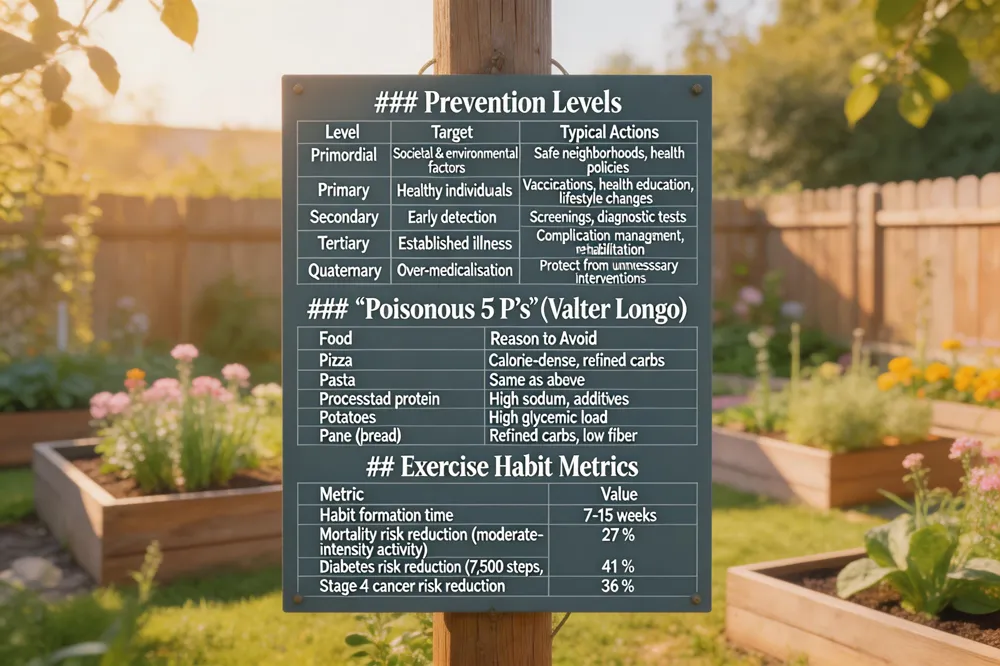 Preventive health strategies are systematic actions aimed at stopping disease before it starts or worsens. They begin with primordial prevention, targeting societal and environmental factors—such as safe neighborhoods and health policies—to reduce the emergence of risk factors across whole populations. Primary prevention then focuses on healthy individuals, using measures like vaccinations, health education, and lifestyle changes to block disease onset. Secondary prevention involves early detection via screenings and diagnostic tests to catch subclinical disease before symptoms appear, while tertiary prevention manages established illnesses to limit complications and promote rehabilitation. Finally, quaternary prevention protects patients from unnecessary medical interventions and over‑medicalization, ensuring care remains safe and ethically appropriate.
The “poisonous 5 P’s” that longevity expert Valter Longo warns against are pizza, pasta, processed protein, potatoes, and pane (bread). These calorie‑dense, refined‑carbohydrate foods promote obesity, insulin resistance and chronic inflammation, shortening health‑span. Substituting plant‑based, nutrient‑dense options supports cellular repair and metabolic balance, helping maintain a youthful biological age.
Forming an exercise habit typically requires 7‑15 weeks, and sustained moderate‑intensity activity cuts all‑cause mortality risk by 27%. Walking 7,500 steps five times weekly for two years reduces type 2 diabetes risk by 41% and stage 4 cancer risk by 36%. AI‑driven platforms can integrate wearable step counts, heart‑rate variability, and other biometric data to deliver hyper‑personalised nudges, reinforcing these habits at scale and accelerating the transition from intention to lasting behavior change.
Economic and Operational Aspects of Health Coaching
Coach Hourly Rates
| Range | Factors Influencing Price |
|---|---|
| $50‑$200 | Credentials (NBHWC, ICF), experience, specialty, location |
AI‑Driven Exercise Program Scalability
| Feature | Benefit |
|---|---|
| Real‑time wearable integration | Adaptive workout plans for thousands simultaneously |
| Automated intensity & nudges | Reduced manual coaching hours, lower cost |
| Deployment contexts | Corporate wellness, remote cardiac rehab, multimorbidity management |
| Data compliance | HIPAA‑compliant pipelines |
Preventive Medicine Officer Pathway (US)
| Step | Requirement |
|---|---|
| 1 | MD or DO degree |
| 2 | U.S. medical license |
| 3 | Accredited preventive medicine residency |
| 4 | Board certification |
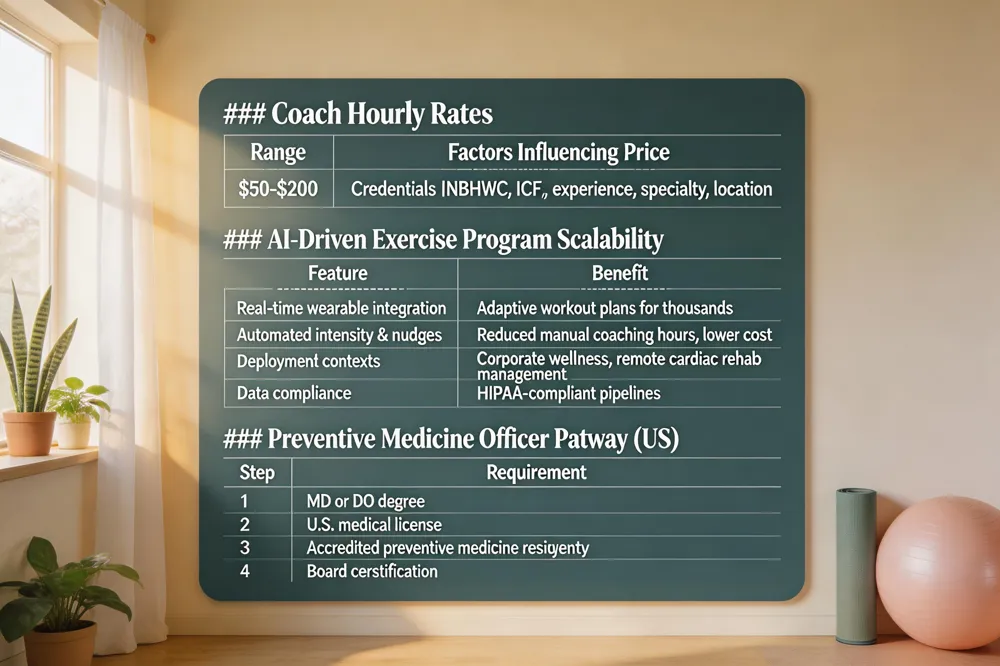 Coach hourly rates – Health‑coach fees typically range from $50 to $200 per hour. The exact price depends on credentials (e.g., NBHWC, ICF), experience, specialty, and location. Urban markets and coaches offering advanced services such as personalized nutrition, fitness programming, or chronic‑illness management tend to charge toward the higher end, while newer practitioners or group/virtual sessions fall near the lower end.
AI‑driven exercise program scalability – AI platforms (e.g., Vitality AI, Thryve, NextLevel) integrate real‑time wearable data, biometric trends, and risk scores to generate adaptive workout plans for thousands of users simultaneously. By automating intensity adjustments, milestone celebrations, and adherence nudges, these systems reduce the need for manual coaching hours, cut costs, and maintain high compliance rates. The result is a scalable model that can be deployed across corporate wellness programs, remote cardiac rehabilitation, and multimorbidity management while preserving clinical safety through HIPAA‑compliant data pipelines.
Career pathway for preventive medicine officers – To become a preventive medicine officer in the United States, one must earn a medical degree (MD or DO), obtain a U.S. medical license, complete an accredited residency in preventive medicine, and achieve board certification. This pathway equips physicians with expertise in population health, risk‑assessment analytics, and the integration of AI‑driven preventive strategies, positioning them to lead large‑scale health‑coaching initiatives and drive measurable reductions in chronic disease burden.
Future Directions: Scaling AI for Longevity
AI Data Integration & Hyper‑Personalisation
| Platform | Data Sources | Reported Improvements |
|---|---|---|
| Longevity AI, Vitality AI, MediKarma | EHRs, wearables, labs, omics | Screening ↑ 22 %, early cancer detection ↑ 19 % |
DAIC Ethical Framework (Designing AI Coach)
| Principle | Description |
|---|---|
| Human‑centric design | Prioritise user agency |
| Privacy‑by‑design | GDPR & HIPAA safeguards |
| Narrow task focus | Specific, measurable outcomes |
| Transparent validation | Open reporting of performance |
AI‑Driven Habit Formation Research
| Outcome | AI‑only Coaching |
|---|---|
| Physical‑activity adherence increase | 15‑30 % |
| Completion rate | 93 % |
| User preference for stage‑specific LLM messages | 68 % |
| Potential mortality risk reduction (7‑15 wk habit) | Up to 58 % |
Six Principles of Personalized Care
- Shared decision‑making
- Personalised care and support planning
- Enabling choice
- Social prescribing & community‑based support
- Supported self‑management
- Personal health budgets
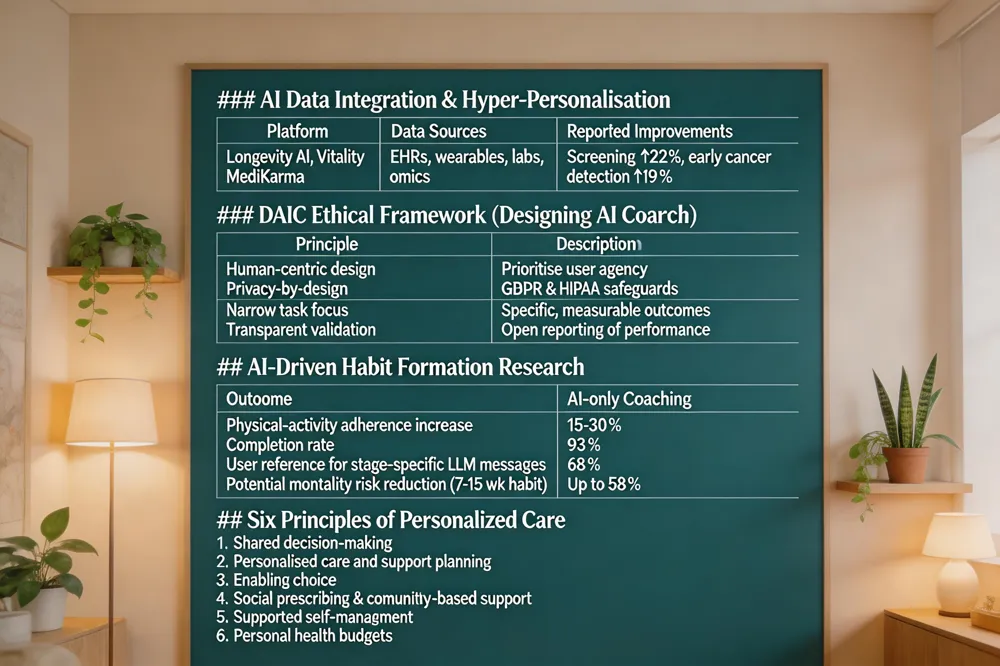 AI data integration and hyper‑personalisation
Modern platforms such as Longevity AI, Vitality AI and MediKarma fuse electronic health records, wearable streams, labs and omics data to generate a unified risk profile. By leveraging Google Vertex AI, Gemini models and 1.6 million EHRs, these systems deliver hyper‑personalised nudges that increase screening rates 1.22‑fold and improve early cancer detection by 19 %. Real‑time biomarker trends allow dynamic adjustment of exercise, nutrition and stress‑management plans, extending healthspan for both young and older adults.
AI data integration and hyper‑personalisation
Modern platforms such as Longevity AI, Vitality AI and MediKarma fuse electronic health records, wearable streams, labs and omics data to generate a unified risk profile. By leveraging Google Vertex AI, Gemini models and 1.6 million EHRs, these systems deliver hyper‑personalised nudges that increase screening rates 1.22‑fold and improve early cancer detection by 19 %. Real‑time biomarker trends allow dynamic adjustment of exercise, nutrition and stress‑management plans, extending healthspan for both young and older adults.
Ethical standards and the DAIC framework The Designing AI Coach (DAIC) framework mandates human‑centric design, privacy‑by‑design, narrow task focus and transparent validation. HIPAA‑compliant pipelines (e.g., ingevity AI, NextLevel) and GDPR safeguards ensure data security while preventing bias and discrimination. Ethical AI must also respect the six principles of personalized care: (1) shared decision‑making, (2) personalised care and support planning, (3) enabling choice, (4) social prescribing and community‑based support, (5) supported self‑management, and (6) personal health budgets.
Research on AI‑driven habit formation Systematic reviews of 35 DHIs show AI‑only coaching can raise physical‑activity adherence by 15‑30 % and achieve 93 % completion rates, though human coaches still score higher on relational alliance. Fine‑tuned LLMs (e.g., MHC‑Coach) produce stage‑specific messages that 68 % of users prefer over human experts with higher action‑verb density and temporal references, supporting the 7‑15‑week habit‑formation window needed to reduce mortality risk by up to 58 %.
What are the 6 principles of personalized care? The six principles of personalized care are: (1) shared decision‑making, (2) personalised care and support planning, (3) enabling choice, (4) social prescribing and community‑based support, (5) supported self‑management, and (6) personal health budgets.
A New Era of Preventive Longevity
AI serves as a catalyst for scale by integrating fragmented health data—from wearables, labs, genomics—into hyper‑personalized risk models that trigger real‑time nudges. Patients gain empowerment through transparent dashboards, AI‑driven insights, and 24/7 coaching that translate complex biomarkers into actionable daily habits. Continuous innovation, exemplified by fine‑tuned LLMs, hybrid human‑AI coaching, and adaptive exercise algorithms, sustains engagement, refines prevention strategies, and accelerates health‑span extension across populations. These platforms also comply with HIPAA and GDPR, ensuring privacy while enabling interventions for groups.